Showing posts with label bass. Show all posts

Sunday, July 12, 2015

Saltwater Fish are Cool Too

A few weeks ago, I wrote a post on my top ten freshwater fish species. Anyone who knows me is fully aware that I have an affinity for freshwater fishing, but that doesn't mean I lack appreciation for the tremendous bounty of amazing fish found in the seas and oceans of the world. Growing up on the northern part of the east coast, saltwater fishing was a staple. Especially cool about it was that you were much more likely to fish from a boat, than if you were fishing freshwater. Sometimes it's invigorating to be out on the open Long Island Sound, sitting at the bow (front) of a swift 17-19 foot vessel, diagonally cutting through waves with the outboard engine screaming, as the salinized wind rapidly evaporates the sweat from your skin, while glancing left and right as land masses fade in the growing distance.

As a (sort of) political peace offering to the previous post, I'd like pay homage to my favorite (local) saltwater fish species:

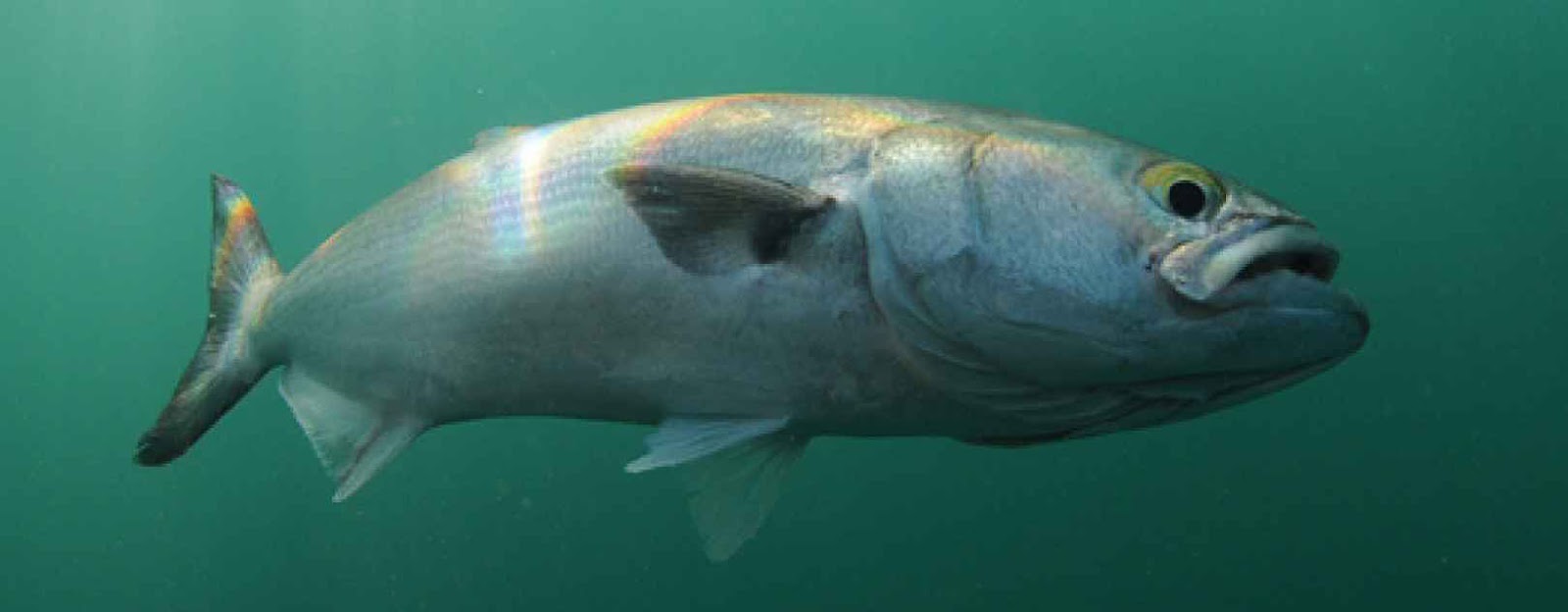
1. Bluefish
Adult bluefish are strong and aggressive, and live in loose groups. They are fast swimmers which prey on schools of forage fish, and continue attacking them in feeding frenzies even after they appear to have eaten their fill.[7][8] Depending on area and season, they favormenhaden and other sardine-like fish (Clupeidae), jacks (Scombridae), weakfish(Sciaenidae), grunts (Haemulidae), striped anchovies (Engraulidae), shrimp, and squid. They are cannibalistic and can destroy their own young.[16] Bluefish sometimes chase bait through the surf zone, attacking schools in very shallow water, churning the water like a washing machine. This behavior is sometimes referred to as a "bluefish blitz".
Bluefish. n.d. https://en.wikipedia.org/wiki/Bluefish (accessed July 12, 2015). 
The striped bass (Morone saxatilis), also called Atlantic striped bass, striper, linesider, pimpfish, rock, or rockfish, is the state fish of MarylandRhode Island, and South Carolina, and the state saltwater (marine) fish of New YorkNew JerseyVirginia, and New Hampshire. They are also found in the Minas BasinGaspereau River, and Northumberland Strait in Nova Scotia, Canada, and theMiramichi River and Saint John River in New Brunswick, Canada. The history of the striped bass fishery in North America dates back to the Colonial period. Many written accounts by some of the first European settlers describe the immense abundance of striped bass along with alewives traveling and spawning up most rivers in the coastal Northeast.
Striped Bass. n.d. https://en.wikipedia.org/wiki/Striped_bass (accessed July 12, 2015).

In its life cycle, an adult flounder has two eyes situated on one side of its head, while at hatching one eye is located on each side of its brain. One eye migrates to the other side of the body as a process of metamorphosis as it grows from larval to juvenile stage. As an adult, a flounder changes its habits and camouflages itself by lying on the bottom of the ocean floor as protection against predators.[1] As a result, the eyes are then on the side which faces up. The side to which the eyes migrate is dependent on the species type. 
Flounder ambush their prey, feeding at soft muddy areas of the sea bottom, near bridge piles, docks and coral reefs. 
A flounder's diet consists mainly of fish spawn, crustaceanspolychaetes and small fish. Flounder typically grow to a length of 12.5–37.5 centimeters (4.9–14.8 in), and as large as 60 centimeters (24 in). Their width is about half their length. Male Platichthys are known to display a pioneering spirit, and have been found up to 80 miles off the coast of northern Sardinia, sometimes with heavy encrustations of various species of barnacle.
Flounder. n.d. https://en.wikipedia.org/wiki/Flounder (accessed July 12, 2015).

4. Porgy (Scup)
The scupStenotomus chrysops, is a fish which occurs primarily in the Atlantic from Massachusetts to South Carolina.[1] Along with many other fish of the family Sparidae, it is also commonly known as porgy.[2] 
Scup grow as large as 18 in (450 mm) and weigh 3 to 4 lb (2 kg), but they average 0.5–1.0 lb (0.25–0.50 kg). 
They are fished for by commercial and recreational fishermen. They are a fine fish to eat because of their light flavor and are sometimes called panfish. Popular methods of cooking include but are not limited to frying, broiling, and baking.
Scup. n.d. https://en.wikipedia.org/wiki/Scup (accessed July 12, 2015). 

5. Blackfish (Tautog)
Popular among fishermen, tautog have a reputation for being a particularly tricky fish to catch. Part of this is because of their tendency to live among rocks and other structures that can cause a fisherman’s line to get snagged. The favorite baits for tautog include: green crabsAsian shore crabsfiddler crabsclamsshrimpmusselssandworms, and lobsters. Tautog fishing may also be difficult due to the tendency of fishermen try to set the hook as soon as they feel a hit, rather than wait for the tautog to swallow the bait. Rigs with minimal beads, swivels and hooks should be used to prevent entanglement with the rocks, reefs or wrecks tautog frequent.[citation needed]Because they are often found in wrecks, they are often seen by scuba divers. They are also popular with spearfishermen, as they are remarkably calm in the presence of divers and are relatively easy to spear.
Tautog. n.d. https://en.wikipedia.org/wiki/Tautog (accessed July 12, 2015).
As mentioned earlier; there's a certain, yet indiscernible allure to saltwater fish. There is also a magnified sense of achievement when they're caught, as their potential range of travel and migration is vastly beyond those of their landlocked cousins. They come in an abundance of colors, shapes, and sizes; plus they can get REALLY BIG. The coolest part: etseemed scientists believe there are (many) saltwater fish species that have yet to be discovered. 

Monday, June 29, 2015

A Family (fishing) Affair

Once a year, typically around mid-June, my family takes a day-long trip on a chartered fishing boat. We usually reserve The Snow Goose, out of Port Chester, NY or The Helen III, out of Groton, CT. Over some time, we've had our good, great, and so-so days, but our 2013 trip aboard The Helen III was truly one for the family photo album AND the record book. Throughout that clear summer day, the fishing was consistently productive, as the phrase, "Fish on!" was shouted repeatedly; sometimes even simultaneously, by many of us. At some points, a few of us had to stow our poles and alternate as the "hold my beer guy" for whomever was hooked into a fish. Fortunately, during that time, the Striped Bass were abundant and HUNGRY.

Later that afternoon, just prior to the bellowing foghorn which signals the return trip to port, a small group began to gather around my cousin, Teddy, who was in a trolling chair at the stern (rear) of the 45 foot vessel, with his fishing rod bent like a question mark. As the sounds of laughter and expletives grew, so did the number of onlookers; Teddy had hooked into something big. For the next fifteen minutes, we watched as he leveraged the rod and cranked steadily at the reel, shortening the distance between himself and whatever was on the other end, by inches at a time. Our glances alternated back and fourth, like tennis spectators, between Teddy and the decreasingly distant point where the line met the water, waiting for our first glimpse of the fish. Finally, as our anticipation peaked, a glimmering silver behemoth broke the choppy surface; then immediately dove back beneath it. We roared at the spectacle and cheered Teddy on, with a newfound sense of immediacy amongst us. He grimaced as he reeled, crank by crank, while adjusting his grip on the rod. Time and time again, the gaping jaws of the fish would surface, then disappear. Teddy is a strong guy, but this battle was weighing heavier on his endurance, with each passing moment. Still, he knew this was potentially the catch of a lifetime, and would do whatever it took to land the fish. He fought with might, eventually pulling the fish close enough for the first-mate to yell, "Net!!"

We cleared a path, stood back and cringed as the fish jerked back and fourth, narrowly dodging the ovular opening of the outstretched net, time and time again. Leaning over the boat's metal safety rail, reading the pattern of the waves, the first-mate maneuvered the net's opening directly below the jowls of the fish and secured it in place; the deal was closed. As he brought the beast onboard, everybody was in awe. It was a massive Striped Bass, weighing in excess of sixty-pounds, which is substantial for the species.

As fatigued as Teddy was from the (24 minute) ordeal, he immediately raised his catch in a celebration of victory, as the rest of us cheered and snapped photos; one which made the cover of The Fisherman magazine, New England Edition, shown below. Some people (obviously out of envy) actually commented online, claiming the image was Photoshopped. They Wish!
It was a fantastic fish finale of what will go down in family history as a memorable event that punctuated an iconic excursion. It's also another example of how fishing lifts spirits and brings people together. Of course, all credit goes to Teddy for his accomplishment, but the beauty of the catch is how connected and united we all were while he was achieving it. 

Still, he'd better enjoy the feeling while it lasts—because next year I'm going to best him, for sure. Watch out, Teddy!

Tuesday, June 23, 2015

My Top 10 North American Freshwater Fish Species

Growing up on the East Coast, I've done a LOT of saltwater fishing over the years and genuinely do enjoy it. However, I'm a freshwater fisherman at heart. Whether ponds, lakes, river or streams, these typically wooded and isolated environments contribute to the therapeutic properties that fishing provides. I also appreciate the diversity of fish species that can be found in one given body of freshwater, which offers increased options and possibilities to a single outing. The following species are my favorites, in no particular order; some I've been fortunate to catch, and others are on my bucket list.

1. Largemouth Bass

Largemouth bass are keenly sought after by anglers and are noted for the excitement of their fight. The fish will often become airborne in their effort to throw the hook, but many say that their cousin species, the smallmouth bass, can beat them pound for pound.[17] Strong cultural pressure among largemouth bass anglers encourages the practice of catch and release, especially the larger specimens, mainly because larger specimens are usually breeding females that contribute heavily to future sport fishing stocks. Largemouth bass, if handled with care, respond well to catch and release. 
Largemouth Bass. n.d. https://en.wikipedia.org/wiki/Largemouth_bass (accessed June 23, 2015).

Rainbow trout are a popular target for fly fishers, and several angling methods are used. The use of lures presented via spinning, casting or trolling techniques is common. Rainbow trout can also be caught on various live and dead natural baits. The International Game Fish Association recognizes the world record for rainbow trout as a fish caught on Saskatchewan'sLake Diefenbaker by Sean Konrad on September 5, 2009. The fish weighed 48 lb (22 kg) and was a genetically modified hatchery escapee.[92]Many anglers consider the rainbow trout the hardest-fighting trout species, as this fish is known for leaping when hooked and putting up a powerful struggle.[93] It is considered one of the top five sport fish in North America and the most important game fish west of the Rocky Mountains.[25]
Rainbow Trout. n.d. https://en.wikipedia.org/wiki/Rainbow_trout (accessed June 23, 2015).


3, Northern Pike:

Pike are aggressive if not given enough space because they are territorial.[10] They use a form of foraging known as sit-and-wait. Unlike species such as perch, pike undergo bursts of energy instead of actively chasing down prey. As such, a fair amount of inactive time occurs until they find prey. Hunting efficiency decreases with competition;[10] the larger the pike, the larger the area controlled by that particular pike. An inverse relation to vegetation density and pike size exists, which is due to the possibility of cannibalism from the largest pike.[11] This makes sense, as the smaller pike need more vegetation to avoid being eaten. Large pike do not have this worry and can afford the luxury of a large line of sight. They prefer a tree structure habitat.[11]
Northern Pike. n.d. https://en.wikipedia.org/wiki/Northern_pike (accessed June 23, 2015).


The first introductions into the U.S. started in 1883 when Fred Mather, a New York pisciculturist and angler, under the authority of the U.S. Fish Commissioner, Spencer Baird, obtained brown trout eggs from a Baron Lucius von Behr, president of the German Fishing Society. The von Behr brown trout came from both mountain streams and large lakes in the Black Forest region of Baden-Württemberg.[6]The original shipment of "von Behr" brown trout eggs were handled by three hatcheries, one on Long Island, the Cold Spring Hatchery operated by Mather, one in Caledonia, New York operated by pisciculturalist Seth Green, and other hatchery in Northville, Michigan.
Brown Trout. n.d. https://en.wikipedia.org/wiki/Brown_trout (accessed June 23, 2015).


 5. Walleye:
Since walleyes have excellent visual acuity under low illumination levels, they tend to feed more extensively at dawn and dusk, on cloudy or overcast days and under choppy conditions when light penetration into the water column is disrupted. Although anglers interpret this as light avoidance, it is merely an expression of the walleye's competitive advantage over its prey under those conditions. Similarly, in darkly stained or turbid waters, walleye tend to feed throughout the day. In the spring and fall walleye are located near the shallower areas due to the spawning grounds; and they are most often located in shallower areas during higher winds due to the murkier, higher oxygenated water at around six feet deep.[6] On calm spring days the walleye are more often located at the deep side of the shoreline drop-off and around shore slopes around or deeper than ten feet.[7]
Walleye. n.d. https://en.wikipedia.org/wiki/Walleye (accessed June 23, 2015).


6. Muskellunge
Anglers seek large muskies as trophies or for sport. The fish attain impressive swimming speeds, but are not particularly maneuverable. The highest-speed runs are usually fairly short, but they can be quite intense. The muskie can also do headshaking in an attempt to rid itself of a hook. Muskies are known for their strength and for their tendency to leap from the water in stunning acrobatic displays. A challenging fish to catch, the muskie has been called "the fish of ten thousand casts". Anglers tend to use smaller lures in spring or during cold-front conditions and larger lures in fall or the heat of summer.
Muskellunge. n.d. https://en.wikipedia.org/wiki/Muskellunge (accessed June 23, 2015).


Sport fishermen have made these cichlids prized game fish for their fighting qualities, so much so that many travel agencies now arrange fishing trips to Brazil and Florida specifically to catch peacock bass. 
Renowned American peacock bass fisherman and fishing author, Larry Larsen, refers to them as "freshwater bullies" due to their ferocious nature when hunting and their tendency to damage and sometimes destroy fishing gear when striking.  
The most common techniques for catching these cichlids are similar to those for catching largemouth bass, with the notable exception that peacock bass usually will not strike artificial worms, a widely used lure among largemouth bass fisherman. In addition, fly fishing techniques, including lures such as poppers and large streamers, are becoming increasingly popular for catching them.
Peacock Bass. n.d. https://en.wikipedia.org/wiki/Peacock_bass (accessed June 23, 2015).


 8. Steelhead Trout:

Steelhead trout can reach up to 55 pounds (25 kg) in weight and 45 inches (120 cm) in length, though average size is much smaller. They are usually dark-olive in color, shading to silvery-white on the underside with a heavily speckled body and a pink to red stripe running along their sides. They are a unique species; individuals develop differently depending on their environment. While all O. mykiss hatch in gravel-bottomed, fast-flowing, well-oxygenated rivers and streams, some stay in fresh water all their lives. These fish are called rainbow trout. The steelhead that migrate to the ocean develop a slimmer profile, become more silvery in color, and typically grow much larger than the rainbow trout that remain in fresh water. Adults migrate from a marine environment into the freshwater streams and rivers of their birth in order to mate (called anadromy). Unlike other Pacific salmonids, they can spawn more than one time (called iteroparity). Migrations can be hundreds of miles. Young animals feed primarily on zooplankton. Adults feed on aquatic and terrestrial insects, mollusks, crustaceans, fish eggs, minnows, and other small fishes (including other trout).
Steelhead Trout. January 15, 2015. http://www.fisheries.noaa.gov/pr/species/fish/steelhead-trout.html (accessed June 23, 2015).


9. Alligator Gar:

The long time public perception of alligator gars as "trash fish", or a "nuisance species" has changed with increasing national and international attention on the species as a sport fish which some have attributed to features on popular television shows. Oklahoma, Texas, Arkansas, Mississippi, and Louisiana allow regulated sport fishing of alligator gars. Texas has one of the best remaining fisheries for alligator gars, and in concert with its efforts to maintain a viable fishery, imposed a one-per-day bag limit on them in 2009.[25] The Texas state record, and world record for the largest alligator gar caught on rod and reel is 279 lb (127 kg), taken by Bill Valverde on January 1, 1951 on the Rio Grande in Texas.[26]
Alligator Gar. n.d. https://en.wikipedia.org/wiki/Alligator_gar (accessed june 23, 2015).


The tiger trout (Salmo trutta X Salvelinus fontinalis) is a sterile, intergeneric hybrid of the brown trout (Salmo trutta) and the brook trout(Salvelinus fontinalis). The name derives from the pronounced vermiculations, evoking the stripes of a tiger. It is a rare phenomenon in the wild, with the brook trout having 84 chromosomes and the brown trout 80.[1][2] Records show instances as far back as 1944.[3] The cross itself is unusual in that the parents are members of different genera
Tiger Trout. n.d. https://en.wikipedia.org/wiki/Tiger_trout (accessed June 23, 2015).


I find great beauty in all the animals listed above, among their similarities and many uniquenesses. North America is a vast, diverse, and magnificent place for freshwater fishing. Throughout any season of the year, you'll find exciting opportunities to revisit your favorite spots to catch the one that got away, or venture out into new territory in search of an encounter with various different species. You never know what you may discover on the other end of the line...

Monday, June 22, 2015

The Saugatuck Reservoir; Prime Connecticut Fishing

In the U.S., there is an abundance of excellent freshwater fishing. Just inside the northeast coastline are many appropriate examples. In Fairfield County, CT, spanning the towns of Redding and Weston, lies the Saugatuck Reservoir; approximately 12 billion gallons of pristine inland marine life which offers an array of angling opportunities for various types of fisherman. What I found peculiar was the lack of publicity the reservoir receives Online, despite its reputation. I searched Wikipedia (considered an oracle to most), sport fishing hubs, online fishing magazines, and even the CT Department of Environmental Protection website. Still, specific information regarding the numerous different fish species contained therein was not readily available. For example, Wikipedia stated:
The Saugatuck Reservoir is a reservoir in Fairfield County, Connecticut, US, that straddles the border between the towns of Redding and Weston. It is created by the Samuel P. Senior dam[2] of the Saugatuck River, and provides water to several of the surrounding towns. It is considered quite scenic and is stocked with trout for fishing. It borders the Devil's Den Preserve in the southwest.
Bridgeport Hydraulic Company Holdings (now owned by Aquarion) flooded the Saugatuck River Valley after 1938[3][4] displacing the village of Valley Forge[5][6] to create the Saugatuck Reservoir.[7]
Aquarion Water Co., owner of the reservoir and dam, allows Tailrace fishing in one area at the Weston end of the reservoir, where it has constructed a handicapped-access area. However, anglers must obtain a permit from Aquarion before fishing in the Saugatuck.[8]
The Saugatuck is the largest of the eight reservoirs that make up Aquarion’s greater Bridgeport water system. It holds about 12 billion US gallons (45,000,000 m3) of water.[9]
Above, only trout are mentioned, which fails to recognize the biological diversity of the Saugatuck Reservoir. That's like reviewing an entire acclaimed film, yet only discussing one character. Also, if I'm to contribute to a central information resource, my credibility is paramount. As the result of personal hands-on experience, and discussions with attending park rangers, I've amended the page to include a full list of fish species thriving there. See below for the (entire) updated entry:
The Saugatuck Reservoir is a reservoir in Fairfield County, Connecticut, US, that straddles the border between the towns of Redding and Weston. It is created by the Samuel P. Senior dam[2] of the Saugatuck River, and provides water to several of the surrounding towns. It is considered quite scenic and is stocked with trout for fishing. It borders the Devil's Den Preserve in the southwest.
Bridgeport Hydraulic Company Holdings (now owned by Aquarion) flooded the Saugatuck River Valley after 1938[3][4] displacing the village of Valley Forge[5][6] to create the Saugatuck Reservoir.[7]
Aquarion Water Co., owner of the reservoir and dam, allows Tailrace fishing in one area at the Weston end of the reservoir, where it has constructed a handicapped-access area. However, anglers must obtain a permit from Aquarion before fishing in the Saugatuck.[8]
The Saugatuck is the largest of the eight reservoirs that make up Aquarion’s greater Bridgeport water system. It holds about 12 billion US gallons (45,000,000 m3) of water.[9]
The following fish species may be found within the Saugatuck Reservoir:
American Eel
Bluegill (Sunfish)
Brook Trout
Brown Trout
Bullhead Catfish
Chain Pickerel
Crappie
Largemouth Bass
Pumpkinseed (Sunfish)
Rainbow Trout
Rock Bass
Smallmouth Bass
Walleye
White Perch
Yellow Perch
Saugatuck Reservoir
Just as certain types of music draw particular types of listeners, so do fish species with specific anglers. Knowing where your desired fishes exist is consistent with knowing where your favorite band is playing. The ultimate objective here is to provide a broader perspective on a wonderful place. Please enjoy!